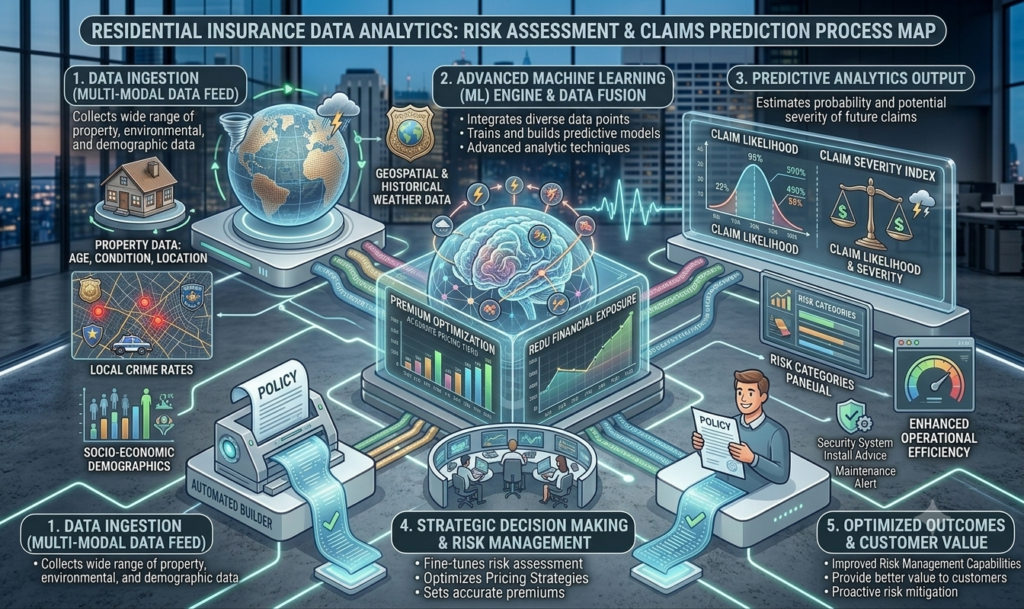
Residential insurance companies rely heavily on data analytics to assess and manage risks associated with underwriting policies. One of the primary use cases is the evaluation of risk factors that could impact the likelihood of claims and their potential severity. By leveraging a wide range of data sources and advanced analytical techniques, insurers can make informed decisions, set accurate premiums, and reduce financial exposure. The process involves collecting and analyzing data on various risk factors, including the property’s location, age, and condition; local crime rates; historical weather patterns; and socio-economic demographics. Advanced machine learning models can then integrate these diverse data points to predict the likelihood of future claims, allowing insurance companies to fine-tune their risk assessment, optimize pricing strategies, and enhance overall operational efficiency. By employing these data-driven insights, residential insurance companies can not only improve their risk management capabilities but also provide better value to their customers through personalized policy recommendations and proactive risk mitigation strategies.
Our AI-Ready Lakehouse and Knowledge Platform delivers a production-grade architecture designed to unify fragmented operational data across APIs, streaming sources, and enterprise applications into a governed, semantic foundation. By implementing a multi-layered Databricks lakehouse design—integrating scalable ingestion, domain-oriented data modeling, and ontology-driven knowledge graphs—the platform transforms raw, inconsistent data into trusted, AI-ready assets. This framework features centralized governance via Unity Catalog and automated CI/CD pipelines, ensuring that data lineage, quality, and security are strictly maintained while reducing the engineering burden of repeatedly reconciling definitions for new analytical use cases. To empower next-generation intelligence, the platform embeds custom AI and retrieval-augmented generation (RAG) workflows directly into the data lifecycle, providing structured context and vector-ready content for LLMs. By combining robust data APIs with advanced performance optimization and monitoring, the architecture separates internal production complexity from downstream consumers, enabling secure, low-latency access to governed data products. This self-healing, scalable foundation eliminates operational friction, enabling data scientists, analysts, and intelligent applications to move beyond isolated tables toward explainable, context-aware decision-making and cross-functional enterprise innovation.